

The Singapore Airlines Business Class baggage allowance is structured around two systems: the weight concept and the piece concept. On most international routes, Business Class travelers are typically allowed up to 40 kg of checked baggage under the weight concept. For flights to and from the United States and Canada, the airline generally applies the piece concept, which permits two checked bags of up to 32 kg each. Cabin baggage usually includes two carry on items with defined size and combined weight limits, along with a personal item.
However, allowances may vary depending on route, fare type, aircraft configuration, and frequent flyer status. Excess, overweight, and oversized baggage charges can apply if limits are exceeded. This guide explains the Singapore Airlines Business Class baggage policy in full operational detail so you can travel confidently and avoid unexpected fees.
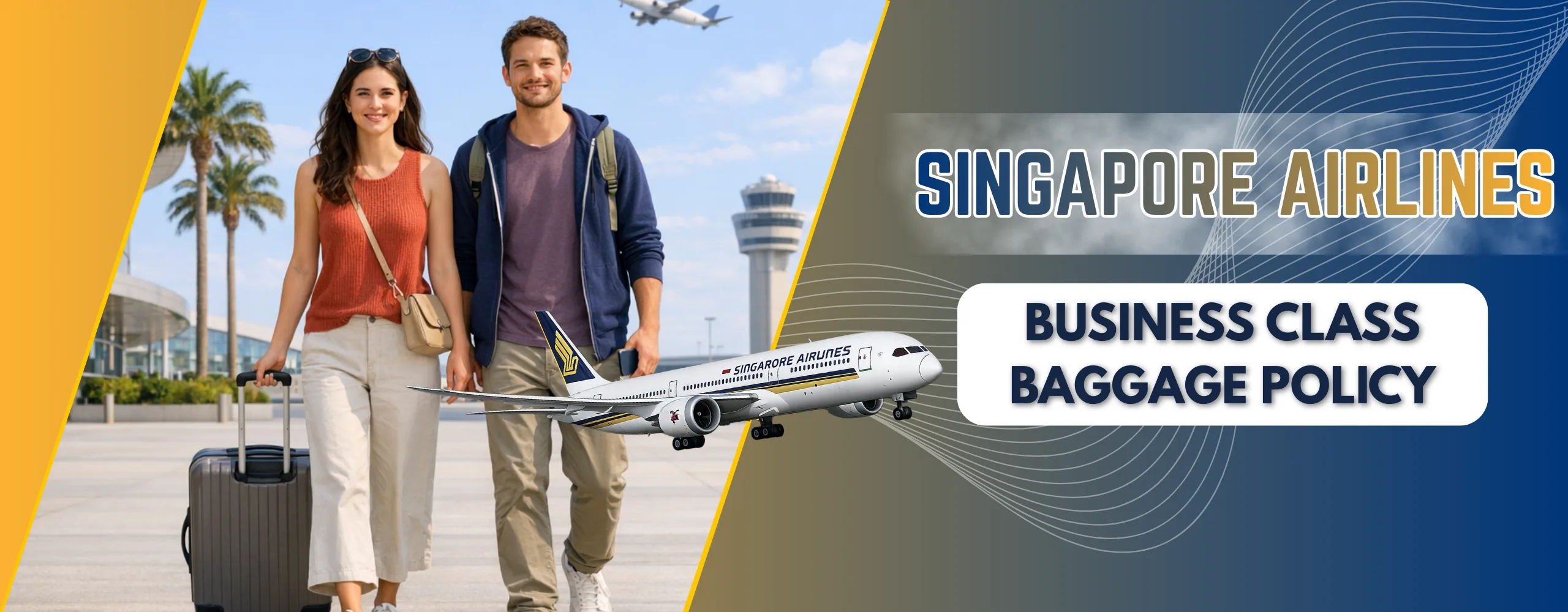
Singapore Airlines Business Class passengers are typically entitled to 40 kg of checked baggage under the weight concept on most international routes. For flights to and from the United States and Canada, the airline applies the piece concept, which generally allows two checked bags up to 32 kg each. Cabin baggage usually includes two carry on bags with a combined weight limit of 15 kg, subject to size restrictions of 115 cm total dimensions per bag. Oversized or overweight baggage may incur additional fees. Allowances can vary based on route, fare family, and frequent flyer status, so travelers should always confirm details before departure.
The Singapore Airlines Business Class baggage allowance depends on your route. On most routes outside North America, the airline uses the weight concept. Business Class travelers typically receive up to 40 kg of total checked baggage. There is no strict limit on the number of bags, provided each bag does not exceed the maximum per piece weight.
For flights involving the United States and Canada, the piece concept applies. Passengers are generally allowed two checked bags, each weighing up to 32 kg. This distinction is critical and directly affects how excess charges are calculated.
Business Class passengers are typically permitted two cabin bags. The combined weight of these bags usually must not exceed 15 kg. Each individual bag must comply with the maximum size restriction of 115 cm in total linear dimensions.
In addition to the two carry on items, passengers may bring a small personal item such as a laptop bag or handbag. Cabin space is subject to aircraft type and load factors. Gate checks may occur if cabin storage becomes limited.
Under the weight concept, Business Class passengers are typically entitled to 40 kg of total checked baggage. This allowance applies across many long haul and regional routes operated by Singapore Airlines.
Each individual checked bag must not exceed 32 kg due to occupational health and safety regulations. Even if your total allowance is 40 kg, a single piece cannot weigh more than 32 kg. Bags exceeding linear size limits may also require special handling or incur oversized fees.
For routes to and from North America, Singapore Airlines applies the piece concept. Business Class passengers are generally allowed two checked bags, each weighing up to 32 kg.
This framework aligns with international baggage agreements and United States Department of Transportation guidelines. Additional bags or overweight items may incur significant charges. If your itinerary includes connecting flights on partner carriers, the most significant carrier rule typically applies, subject to international interline baggage agreements.
The Singapore Airlines Business Class baggage policy is built around international aviation standards. Airlines apply either the weight concept or the piece concept depending on geographic markets and regulatory alignment.
The weight concept focuses on total kilograms permitted, regardless of how many bags are checked. The piece concept limits the number of bags and sets a maximum weight per bag. Business Class benefits are designed to reflect premium fare structures while remaining consistent with international safety and handling limits.
Business Class baggage allowances apply to passengers holding confirmed Business Class tickets on Singapore Airlines operated flights. This includes revenue tickets, certain upgrade bookings, and eligible redemption fares.
Passengers traveling on codeshare flights operated by partner airlines may be subject to the operating carrier’s baggage rules. It is important to check the ticketed operating carrier, not just the marketing carrier, when determining baggage rights.
Frequent flyer members may receive additional allowances, which are addressed in a later section.
Baggage rules vary because airlines operate across multiple regulatory jurisdictions. North American routes typically follow the piece concept due to regulatory frameworks and industry alignment.
Other international routes frequently use the weight concept, which is widely adopted in Asia and parts of Europe. Fare types may also influence flexibility for changes or refunds, though base Business Class baggage entitlements are generally standardized across fare families within the same cabin.
Business Class passengers are typically permitted two carry on bags. This is a premium cabin benefit compared to Economy Class, which often allows one primary cabin bag.
These two items must meet individual size restrictions and fall within the combined weight allowance. Cabin baggage must fit either in the overhead compartment or under the seat in front of you. Cabin crew retain discretion to require gate checking if safety or space limitations arise.
Yes, in most cases you can bring two carry on bags in Singapore Airlines Business Class. The airline’s standard policy allows two pieces with a combined maximum weight of 15 kg.
Each bag must not exceed 115 cm in total linear dimensions. This measurement includes length, width, and height combined. If either item exceeds weight or size limits, it may need to be checked at the gate and could be subject to checked baggage rules.
In addition to two carry on bags, passengers may bring a small personal item. This is designed to accommodate essential items needed during flight.
The personal item should fit under the seat and not obstruct the aisle. It must be compact and manageable. Larger or rigid items may be reclassified as standard cabin baggage if they exceed personal item dimensions.
Laptop bags are generally permitted as a personal item if they are slim and compact. They should contain essential electronics and documents only.
Oversized computer cases may be counted as one of the two permitted cabin bags. Security screening rules apply at departure airports and may vary by country. Electronics must comply with lithium battery safety regulations.
Handbags and small briefcases are usually accepted as personal items. They should be proportionate to standard under seat storage space.
If a handbag is large or structured similarly to a carry on suitcase, it may be counted within the two bag cabin allowance. Airport staff may visually assess size at check in or boarding gates.
Passengers may also carry small items such as:
These items must not create storage challenges or safety concerns. Cabin crew have final authority regarding onboard item placement.
Under the Singapore Airlines Business Class carry on baggage allowance, passengers may bring two cabin bags with a combined maximum weight of 15 kg. There is typically no officially published per bag weight split, but each item must be light enough for the passenger to lift safely into the overhead compartment without assistance. Airport staff may request that cabin bags be weighed at check in or the boarding gate. If the combined weight exceeds 15 kg, excess items may need to be checked and could incur additional charges.
Each cabin bag must not exceed 115 cm in total linear dimensions, calculated by adding length, width, and height. This includes wheels, handles, and external pockets. The purpose of this limit is to ensure safe stowage in overhead bins or under seat compartments. Aircraft type may influence actual bin capacity, especially on regional routes using smaller wide body or narrow body aircraft. Bags exceeding size limits may be tagged for gate check and processed as checked baggage under applicable rules.
The 15 kg combined limit means the total weight of both cabin bags together must remain within this threshold. For example, one bag may weigh 8 kg and the other 7 kg, provided the total does not exceed 15 kg. This structure provides flexibility for Business Class travelers who may carry work materials or personal items. However, airport staff have authority to enforce compliance if weight appears excessive. If redistribution is not possible, the airline may require one bag to be checked.
Cabin baggage is subject to security screening under the regulations of the departure country. Liquids, aerosols, and gels must comply with international security restrictions. At the boarding gate, staff may conduct size or weight checks, particularly on full flights. If overhead bin space becomes limited, cabin crew may request voluntary gate checking. While Business Class cabins generally have generous storage, safety regulations always take priority over entitlement.
For most routes outside North America, Singapore Airlines applies the weight concept to Business Class checked baggage. The standard allowance is typically 40 kg per passenger. Travelers may divide this total weight across multiple bags, provided each individual bag does not exceed the per piece maximum weight limit. This structure offers flexibility for long haul travel, especially for extended stays or multi destination journeys. The total weight allowance applies per ticketed passenger and cannot be pooled unless permitted under group travel arrangements.
Under the weight concept, the total allowance is generally 40 kg. However, each individual checked bag must not exceed 32 kg. This limit is based on international occupational safety standards for baggage handling personnel. Even if a passenger remains within the 40 kg total allowance, a single bag weighing more than 32 kg will not be accepted without repacking. Travelers planning to carry heavy items should distribute weight evenly across multiple suitcases.
Regardless of route, Singapore Airlines typically restricts individual checked bags to a maximum of 32 kg. Bags exceeding this weight may be refused or require repacking at the airport. This rule applies even on North American routes where the piece concept allows two bags of up to 32 kg each. The per piece cap ensures compliance with ground handling safety protocols. Travelers should weigh luggage before departure to avoid last minute adjustments at check in counters.
Checked baggage must usually not exceed 158 cm in total linear dimensions. This includes the sum of length, width, and height, inclusive of wheels and handles. Bags exceeding this size may be classified as oversized and subject to additional fees or special handling requirements. Certain bulky items may require advance approval. Oversized baggage handling depends on aircraft cargo hold capacity and airport infrastructure at both origin and destination.
The weight concept allows passengers to check baggage up to a total combined weight limit rather than restricting the number of pieces. For Singapore Airlines Business Class, this is typically 40 kg. Passengers may divide this weight across two or more bags, provided each bag remains under the 32 kg per piece cap. This system is common across Asia, Europe, and many international markets. It provides flexibility for travelers who prefer distributing belongings across multiple suitcases.
The piece concept restricts both the number of bags and the maximum weight per bag. On routes to and from the United States and Canada, Business Class passengers are generally entitled to two checked bags, each weighing up to 32 kg. Additional bags beyond the two piece allowance incur excess baggage charges. Even if a bag weighs less than 32 kg, exceeding the permitted number of pieces triggers fees. This framework aligns with North American regulatory practice.
Most routes operated by Singapore Airlines outside North America follow the weight concept. Flights between Singapore and destinations in Asia, Europe, Australia, and parts of the Middle East typically use the 40 kg model for Business Class.
Routes to and from the United States and Canada apply the piece concept. When itineraries include mixed regions, the most significant carrier rule generally determines which concept applies across the entire journey.
Different baggage systems reflect regulatory alignment, industry standards, and commercial practice in specific markets. The piece concept is widely used in North America to simplify passenger understanding and interline coordination. The weight concept remains common in Asia and other international regions where total weight flexibility is preferred. Singapore Airlines aligns its baggage structure with these global frameworks to ensure operational consistency and regulatory compliance across its international network.
For flights between Singapore and North America, Business Class passengers are generally allowed two checked bags under the piece concept. Each bag may weigh up to 32 kg. This allowance applies per ticketed passenger. Additional pieces beyond the two bag limit are subject to excess baggage charges. Travelers should review their electronic ticket or booking confirmation to confirm eligibility, particularly if the itinerary includes codeshare segments operated by partner airlines.
Under the piece concept, each of the two permitted checked bags may weigh up to 32 kg. Bags weighing more than 32 kg are typically not accepted due to safety regulations. If a bag weighs between 23 kg and 32 kg, it remains within Business Class entitlement on North American routes. However, exceeding 32 kg may require repacking or shipment via cargo services. Weight distribution is critical for compliance and smooth airport processing.
When itineraries involve both North American and non North American segments, baggage rules are usually determined by the most significant carrier principle under international baggage agreements. If Singapore Airlines is the marketing and operating carrier on the longest international sector, its piece concept allowance typically governs the entire itinerary. However, partner operated segments may apply additional operational restrictions. Travelers should verify baggage through check in documentation before departure.
Transpacific travel often involves long journey times and multiple climate zones. While Business Class offers generous baggage rights, passengers should still monitor total weight and piece count carefully. Oversized or specialty items may require advance notice. It is advisable to review the official baggage information published on the Singapore Airlines before departure, especially when traveling during peak holiday seasons or with complex connecting itineraries.
Singapore Airlines generally limits checked baggage to 158 cm in total linear dimensions. This measurement includes length, width, and height combined, and it accounts for wheels, handles, and external pockets. The 158 cm rule applies under both the weight concept and the piece concept. Bags exceeding this limit may be classified as oversized, even if they remain within the permitted weight. The purpose of this restriction is to ensure compatibility with aircraft cargo hold configurations and automated baggage systems at international airports.
If a checked item exceeds 158 cm in linear dimensions, it may be accepted only with additional charges or advance approval. Oversized baggage handling depends on aircraft type, cargo hold space, and airport infrastructure. In certain cases, passengers may be required to notify the airline before departure, especially for unusually shaped or rigid items. Acceptance is not guaranteed if the item cannot be safely loaded. Fees for oversized luggage vary by route and are typically calculated per sector.
Certain items require special handling due to their size, fragility, or structure. Examples include surfboards, large musical instruments, and bulky sports gear. These items may be subject to special service fees even if they fall within standard weight limits. Singapore Airlines evaluates these items at check in to determine suitability for carriage. Passengers are encouraged to use protective cases and notify the airline in advance to reduce the risk of refusal or delay during departure processing.
If baggage exceeds the permitted weight or piece allowance, excess baggage charges apply. Under the weight concept, fees are calculated based on the number of kilograms exceeding the entitlement. Under the piece concept, charges are applied for additional bags beyond the allowed number or for overweight pieces. Payment is typically required at the airport before boarding. Rates vary by route and sector distance. Charges are generally higher when paid at the airport compared to prepaid online options.
On routes using the weight concept, Business Class passengers receive a 40 kg allowance. If total checked baggage exceeds this limit, fees are charged per additional kilogram. The rate per kilogram depends on the origin and destination regions. Excess weight charges can accumulate quickly on long haul sectors. Travelers are advised to review route specific rates before departure to avoid unexpected costs. Prepaid excess baggage options are often more economical than airport counter rates.
For North American routes following the piece concept, Business Class travelers are typically entitled to two checked bags up to 32 kg each. A third bag or any additional piece beyond the allowance triggers a fixed excess baggage fee per piece. If one of the permitted bags exceeds 32 kg, it may be refused or subject to special cargo handling. Charges are assessed per flight sector and may vary depending on the direction of travel.
If a single checked bag exceeds 32 kg, it generally will not be accepted as checked baggage due to safety regulations. Passengers may be required to repack or redistribute contents into additional bags. In some cases, extremely heavy items must be shipped as cargo rather than as passenger baggage. Ground staff assess compliance at check in. To avoid disruption, passengers should weigh bags before leaving for the airport, particularly when carrying dense items such as books or equipment.
Singapore Airlines typically offers prepaid excess baggage options through its official booking management system. Passengers may purchase additional weight under the weight concept or extra pieces under the piece concept before arriving at the airport. Prepaid options are usually available up to a specified number of hours before departure. Availability may depend on route and aircraft capacity. Purchasing in advance often results in lower rates compared to paying at the airport.
Prepaid excess baggage rates are generally discounted compared to airport counter charges. This structure encourages early confirmation of baggage needs and helps the airline manage cargo planning. Discounts vary by region and distance. Once purchased, additional baggage allowance is typically attached to the ticket and reflected in the reservation system. However, changes to the itinerary may affect prepaid baggage validity, so travelers should confirm conditions when modifying flights.
Passengers who exceed baggage limits without prepayment may purchase excess allowance at the airport check in counter. Airport rates are generally higher and may be subject to currency conversion at the local station. Payment methods vary by airport location. During peak travel periods, additional baggage acceptance may depend on aircraft load factors. In rare cases, if cargo capacity is full, excess baggage may be transported on a later flight.
Extra baggage may not be accepted if aircraft weight restrictions apply or if cargo hold capacity is fully allocated. Seasonal demand, operational constraints, and safety regulations influence acceptance. Certain restricted items may also be refused regardless of payment. Passengers traveling on multi sector itineraries with different operating carriers should verify that each segment can accommodate the additional baggage. Acceptance remains subject to operational approval at the departure airport.
Members of the KrisFlyer Elite Silver and Elite Gold tiers may receive additional baggage benefits depending on route and concept applied. Under the weight concept, an additional weight allowance may be granted. Under the piece concept, an extra piece may be permitted on eligible itineraries. Benefits apply only when the frequent flyer number is included in the reservation. Eligibility rules can vary by fare type and operating carrier.
PPS Club and Solitaire PPS Club members typically receive enhanced baggage privileges beyond standard Business Class allowances. Under the weight concept, additional kilograms may be added to the base 40 kg entitlement. Under the piece concept, extra pieces may be granted depending on route. These benefits reflect loyalty recognition rather than cabin class alone. Travelers should ensure their membership status is correctly reflected in the booking to receive applicable allowances.
Frequent flyer status can modify the base Singapore Airlines Business Class baggage allowance. The structure depends on whether the route follows the weight or piece concept. Additional allowances are usually cumulative with the cabin entitlement rather than replacing it. However, benefits do not override safety limits such as the 32 kg maximum per individual bag. Status benefits typically apply only on flights operated by Singapore Airlines.
When eligible, Business Class baggage allowances and frequent flyer benefits are combined. For example, a Business Class passenger under the weight concept may receive 40 kg plus additional weight based on status tier. Under the piece concept, two checked bags may increase to three where permitted. Final allowance details are displayed in the booking record. Travelers should verify their confirmed entitlement before packing to avoid confusion at check in.
Sports equipment may be accepted as part of the standard checked baggage allowance if it falls within size and weight limits. If it exceeds these limits, special handling fees may apply. Advance notification is recommended for bulky items. Acceptance depends on aircraft type and cargo hold capacity. Protective packaging is strongly advised. Equipment that is inadequately packed may be refused or accepted with limited liability conditions.
Golf bags are commonly transported and may be included within the checked baggage allowance if they remain within 32 kg and 158 cm limits. If a golf bag exceeds linear dimension limits, oversized charges may apply. Other sports gear such as skis or diving equipment is subject to similar assessment. Travelers should confirm route specific conditions in advance to ensure smooth processing.
Bicycles must typically be packed in a protective case or box with pedals removed and handlebars secured. Due to size, bicycles often exceed standard dimension limits and may incur oversized fees. Advance approval is recommended. Acceptance depends on aircraft cargo configuration. Weight restrictions still apply, and individual items must not exceed 32 kg.
Small musical instruments may be carried in the cabin if they meet size and weight requirements. Larger instruments may require purchase of an additional seat or transport as checked baggage. Fragile items should be properly cushioned. Singapore Airlines may request a limited liability declaration for delicate articles. Cabin acceptance depends on available space and safety considerations at boarding.
Mobility aids such as wheelchairs are typically transported free of charge and are not counted toward baggage allowance. Medical devices required for personal use are usually permitted in addition to standard cabin baggage. Battery powered mobility devices must comply with dangerous goods regulations. Advance notice is recommended to coordinate assistance and ensure regulatory compliance at departure and arrival airports.
Infants traveling without a purchased seat generally receive a limited checked baggage allowance. On weight concept routes, this is often up to 10 kg. On piece concept routes, one checked bag of up to 23 kg may be allowed, depending on route. Allowances may vary slightly based on fare conditions. Parents should confirm details before departure to avoid confusion at check in.
One collapsible stroller or pushchair is typically permitted per infant. It may be checked at the counter or gate depending on airport procedures. Strollers are usually transported free of charge in addition to the infant’s baggage allowance. Car seats may also be accepted if properly secured and compliant with aviation safety standards. Advance coordination is advisable for smooth boarding.
Parents traveling in Business Class retain their standard cabin baggage allowance. Infant essentials such as formula, baby food, and diapers for the duration of the flight are generally permitted in reasonable quantities. Security screening rules for liquids still apply. Additional baby items must remain compact and stowable. Cabin crew may assist with storage placement where feasible.
On long haul flights, infant baggage allowances follow the same structural concepts as adult entitlements but at reduced levels. Regulations vary depending on whether the route uses the weight or piece concept. It is important to confirm allowance details for multi sector itineraries. Requirements may differ when connecting with other carriers. Reviewing ticket conditions before departure helps avoid last minute packing adjustments.
If checked baggage does not arrive at the destination, passengers should report the issue immediately at the airport baggage service counter. A Property Irregularity Report is typically created. This report allows tracking within the airline’s global baggage tracing system. Prompt reporting improves recovery speed. Passengers should retain boarding passes and baggage claim tags for reference during the tracing process.
Singapore Airlines provides baggage tracking updates through its customer service channels and online support tools. Once a report is filed, passengers receive a reference number for monitoring status. The airline coordinates with ground handling agents across its network to locate and forward delayed baggage. Most delayed items are returned within a few days, subject to international transfer logistics.
Compensation for delayed or lost baggage is governed by international conventions such as the Montreal Convention. Liability limits are defined in Special Drawing Rights and converted into local currency. Claims must be submitted within specified timeframes. Reimbursement for essential purchases may be considered if baggage is delayed. Passengers should retain receipts and follow formal claim submission procedures outlined by the airline.
Travelers can reduce disruption by packing essential medications and valuables in cabin baggage. Using luggage tags with contact details increases recovery likelihood. Photographing luggage before departure can assist in identification. In the event of a delay, maintaining communication with airline representatives helps track progress. Keeping documentation organized simplifies any potential reimbursement process.
Even with generous Business Class allowances, strategic packing reduces stress at the airport. Distribute weight evenly across multiple bags to remain under the 32 kg per piece cap. Use lightweight suitcases to maximize usable weight. Consider weather and itinerary duration when selecting clothing. Reviewing your confirmed baggage allowance in advance ensures compliance with route specific rules.
Business Class permits two cabin bags with a combined weight of 15 kg. Prioritize essential items such as electronics, travel documents, and valuables. Avoid overpacking dense materials that could exceed weight limits. Ensure each bag remains within 115 cm linear dimensions. Efficient use of cabin baggage minimizes reliance on checked luggage and reduces risk during tight connections.
Baggage policies may change due to regulatory updates or fare adjustments. Always review the most recent guidelines on the official Singapore Airlines website (www.singaporeair.com) before departure. Confirm whether your route uses the weight or piece concept. Verify frequent flyer benefits are correctly reflected in your booking. Taking a few minutes to confirm policy details can prevent unexpected airport charges.
When itineraries include partner airlines, baggage rules may differ. The most significant carrier rule usually applies, but operational differences can occur. Verify whether baggage is checked through to the final destination. If separate tickets are involved, allowances may not combine automatically. Clarifying these details before travel helps ensure a smoother experience across international connections.
The Singapore Airlines Business Class baggage policy offers one of the more generous premium cabin allowances in international aviation, whether under the 40 kg weight concept or the two pieces of 32 kg structure for North America. However, route, aircraft, and frequent flyer status can influence the final entitlement.
Before departure, review your ticket conditions carefully and confirm the latest baggage rules directly on the official Singapore Airlines website. Thoughtful preparation ensures you enjoy the comfort of Business Class without unexpected baggage fees.
For more premium travel guidance, consider reviewing our related resources on efficient packing strategies and managing international connections with confidence.
The Singapore Airlines Business Class Baggage Policy provides a structured framework that helps premium travelers plan luggage with confidence on international journeys. Most long haul routes operate under the weight concept, where the checked baggage allowance typically reaches 40 kg, alongside two pieces of carry on baggage and a personal item. These limits form the core of the Singapore Airlines Business Class baggage allowance, though the exact allowance may vary by route, fare type, and frequent flyer benefits. Reviewing the official guidance from Singapore Airlines or trusted aviation policy sources such as IATA helps travelers confirm details before departure.
Understanding Singapore Airlines business class baggage rules can make a noticeable difference in overall travel comfort. Long haul passengers, families, and KrisFlyer elite members often benefit the most from the generous structure. However, codeshare flights, partner airlines within the Star Alliance network, and IATA first marketing carrier standards may influence which baggage policy applies. Planning ahead also helps travelers avoid unexpected Singapore Airlines excess baggage fees, which are usually calculated by weight or piece depending on the route.
For travelers who want guidance when planning international premium travel, Ticket Business Class can assist with fare options and baggage questions. For personalized support, contact +1-877-243-8320 to speak with a travel specialist before booking.
For most international flights excluding the US and Canada, Singapore Airlines Business Class passengers have a free checked baggage allowance of 40 kilograms total. For flights to or from the United States and Canada, the allowance is two pieces, each weighing up to 32 kilograms. No single bag may exceed 32kg due to safety regulations. For booking assistance, you may contact Ticket Business Class at +1-877-243-8320.
The maximum weight per individual checked bag in Singapore Airlines Business Class is 32 kilograms. While your total allowance may be 40kg, this restriction ensures compliance with international safety standards for baggage handling. Any bag exceeding this limit must be repacked to avoid being refused for carriage.
Yes, Singapore Airlines Business Class passengers are permitted to bring two pieces of cabin baggage onto the aircraft. Each piece must not exceed 7 kilograms and must fit within the total dimension limit of 115 centimeters (L+W+H). This is in addition to a small personal item like a handbag or laptop bag.
Yes, a generous free checked baggage allowance is always included in the Singapore Airlines Business Class fare. The specific allowance depends on your destination, operating under either a weight concept (40kg total) for most routes or a piece concept (two 32kg bags) for flights to/from the US and Canada.
Yes, passengers can bring extra baggage, but excess charges will apply. The cost varies depending on the route and weight. KrisFlyer Elite Gold and PPS Club members enjoy additional baggage allowances, which effectively increases their free limit without needing to pay for excess baggage.
For checked baggage in Singapore Airlines Business Class, the maximum dimensions for any single piece are 158 centimeters when you add the length, width, and height. For carry-on luggage, each piece must have total dimensions not exceeding 115 centimeters to ensure it fits securely in the overhead bin.
Absolutely. KrisFlyer Elite Gold and Star Alliance Gold members flying Singapore Airlines Business Class receive an additional 20 kilograms of allowance on weight-concept routes. On piece-concept routes to/from the US and Canada, these members are entitled to one extra piece, each up to 32 kilograms.
For all flights to and from the United States, Singapore Airlines Business Class uses the "piece concept." Your limit is two separate bags, with each piece weighing a maximum of 32 kilograms. This differs from the "weight concept" used on most other international routes where a total weight limit applies.
On most routes (excluding the US and Canada) using the weight concept, Singapore Airlines allows passengers traveling together and checking in at the same time to combine their baggage allowance. This means a couple in Business Class could have a combined total of 80kg, distributed across their bags, as long as no single bag exceeds 32kg.
If your luggage exceeds the free Singapore Airlines Business Class allowance, you will need to pay an excess baggage fee at the airport. Rates depend on the route and weight. To avoid potential high fees, you can prepay for additional baggage online through the airline’s "Manage My Booking" portal before your flight.
Yes, items like golf clubs, skis, and surfboards are generally accepted as part of your standard Singapore Airlines Business Class checked baggage allowance. They must be packed securely in appropriate protective cases and adhere to the overall weight and size restrictions to avoid excess charges.
The weight limit for each piece of hand baggage in Singapore Airlines Business Class is 7 kilograms. This limit applies to both of the two allowed cabin bags. Any personal items, such as a laptop bag, are not subject to the same weight rule but must be small enough to fit under the seat.
If your checked baggage is delayed or lost, you must immediately report it to the Singapore Airlines Lost & Found office at your arrival airport before leaving the baggage claim area. You can also track the status of your delayed bag through the official SingaporeAir mobile app using your file reference number. If you need assistance with a new booking while waiting for your bags, contact Ticket Business Class at +1-877-243-8320. We are an independent agency.
Yes, small musical instruments like a violin or flute may be carried in the cabin if they fit within the carry-on size and weight limits (7kg, 115cm), counting as one of your two allowed cabin bags. Larger instruments will require the purchase of an additional seat or must be checked in.
On most routes, Singapore Airlines uses a "weight concept" for Business Class. This means you have a total weight allowance, typically 40 kilograms, to use across all your checked bags. For example, you could check in two 20kg bags or one 30kg bag and one 10kg bag, as long as no single bag exceeds the 32kg safety limit.
Yes, flights to and from Canada follow the same "piece concept" as the United States. Singapore Airlines Business Class passengers on these routes are allowed two pieces of checked baggage, with a maximum weight of 32 kilograms per piece. This is a standard policy for trans-Pacific flights to North America.
In addition to your two 7kg cabin bags, Singapore Airlines Business Class allows one small personal item. This typically includes a handbag, a laptop bag, a camera bag, or a small backpack. This item must be compact enough to be stored under the seat in front of you during the flight.
Yes, infants (under two years old) not occupying a seat on Singapore Airlines Business Class are usually entitled to a checked baggage allowance. This is typically 10 kilograms, regardless of the adult's allowance, plus a fully collapsible stroller or pushchair which can often be checked at the gate.
Singapore Airlines does not charge specific fees for transporting fragile items, provided they are packed correctly. Fragile items like wine or art are accepted as part of your standard Business Class checked baggage allowance. It is your responsibility to ensure they are in rigid, crush-proof packaging to prevent damage.
For specific questions about your itinerary's baggage allowance or if you need assistance booking a flight where the baggage rules meet your needs, you can contact Ticket Business Class. We can help clarify the policies for your specific route. You may reach us at +1-877-243-8320. Ticket Business Class is an independent travel agency and is not affiliated with or endorsed by any airline.
 Expert Travel Assistance
Instant Booking Confirmation
Flexible 24-Hour Cancellation
Book Now, Pay Later Options
Exclusive Business Class Deals
Swiss International Air Lines Business Class Baggage Policy lets you bring two checked bags and one carry-on. Check weight limits and fees to ensure smooth, hassle-free travel.
Read More
Turkish Airlines Business Class Baggage Policy allows two checked bags and one carry-on. Review weight limits and fees to travel comfortably and avoid extra charges.
Read More
United Airlines Polaris Business Class Baggage Policy lets you bring two checked bags and one carry-on. Check weight limits and fees for a smooth, stress-free journey.
Read More